Raisebore Stability
This app was developed by Ezra Drieka as part of his Master of Geotechnical Engineering at the University of Exeter (2023). His thesis report covers the detailed background of Raisebore Stability that this documentation summarises.
Supported Data Types
- Input Rock Mass Classification data (Q system) from the Rock Mass Data Suite (direct link, no need to further manipulation)
- Need to assign in mXrap Orientation rating and Weathering rating
Key Features
- Can use Q values from data or calculate Q from Q’ and
- Jw and SRF columns
- Override Jw
- Auto-Calculated SRF from topography survey or mean surface level
- Can adjust the orientation rating and weathering rating for each hole, for different depth along the borehole OR assign default values for all unspecified borehole
- Critical Parameters charts…
- Maximum Unsupported Span (MSUS) charts and tables…
- Summary tables of Qr and MSUS for all holes and 3D view
- Kirsch solution
Authors
Principal author: Ezra Drieka
Other contributors: Daniel Cumming-Potvin, Audrey Goulet
Citation
Drieka, E,Cumming-Potvin, D, & Goulet, A, 2025, mXrap software app, Raisebore Stability - Rock Mass Data Suite, Australian Centre for Geomechanics, Perth, mxrap.com
Publications
Drieka, E, (2023). Raisebore Stability Assessment in Carrapateena Mine and the Development of a Raisebore Stability App in the Mxrap. Thesis report, University of Exeter
Theory
Rock Mass Classification for Raisebored Shafts (Qr) - (McCracken and Stacey, 1989)
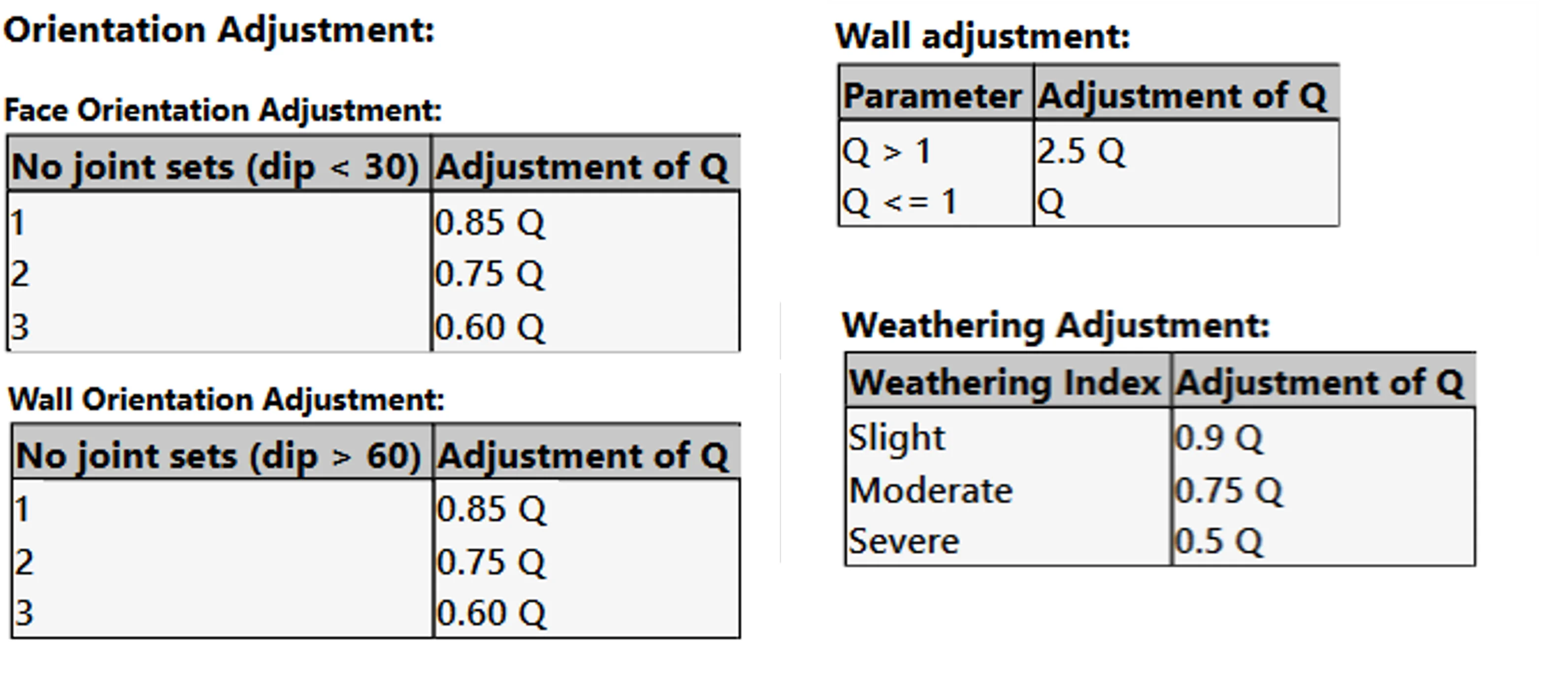
McCracken and Stacey (1989) proposed an updated version of rock mass classification for raisebored vertical shaft developed from the Q-system, which was originally developed for horizontal underground openings (Barton et al., 1974). In addition to the Q-value, additional conditions that are considered to assess the raisebore stability by the M&S methods are: wall, orientation, and weathering adjustments.
- Wall adjustment - The shaft wall as opposed to the excavation roof controls final stability.
- Orientation adjustment - The orientation of the shaft with respect to structural features.
- Weathering adjustment - The weatherability of the rock mass.
The rock mass raise bore quality is calculated by multiplying the original Q-value of the rock mass with adjustment factors as seen below:
Qr = Q x wall adjustment x orientation adjustment x weathering adjustment
Maximum Unsupported Span (MSUS)
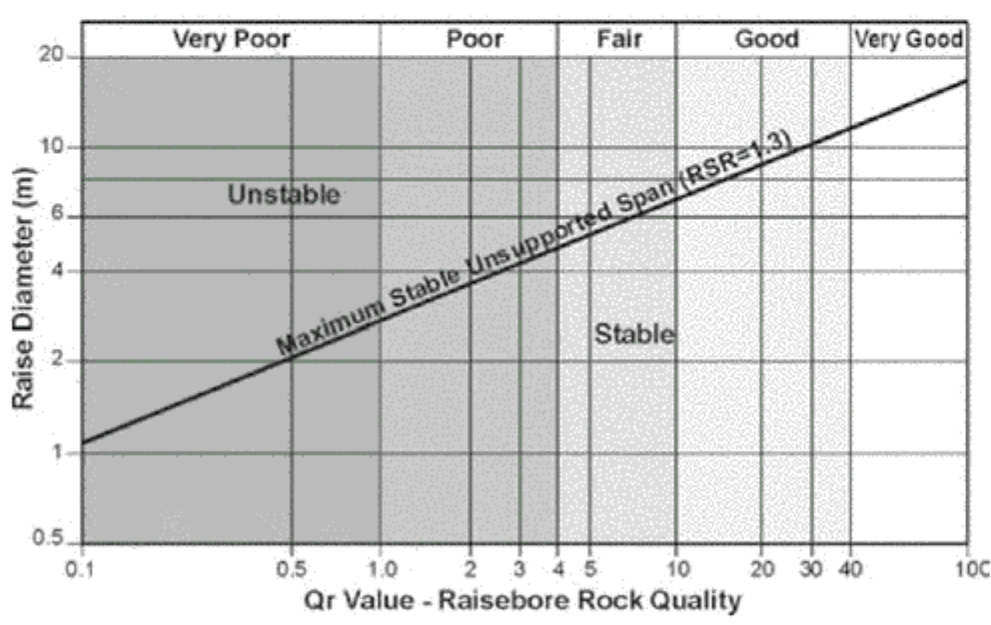
The MSUS represents the maximum diameter of the raise that can be constructed before it fails.
MSUS is calculated as MSUS (metre) = 2 x RSR x Q^[0.4]
Figure below illustrates the relationship between MSUS and the Q-value at a RSR of 1.3 (from Peck and Lee, 2007 after McCracken and Stacey, 1989):
Critical Parameters (Lower-bound Qr, RQD/Jn, Jr/Ja, Jw/SRF)
In general, it is not sufficient to just analyse the variation of MSUS with depth. The range and distribution of other critical parameters such as the raise-bore rock quality (Qr), and the RQD/Jn and the Jr/Ja parameters should also be considered and compared to the required minima for stability at the proposed shaft diameter (Lyle et al., 2017; Peck et al., 2011; Penney et al., 2018).
Lower-bound Qr value and Logging Interval
The lower-bound Qr value is a critical geotechnical parameter in the M&S method for determining the maximum diameter at which a raise can be reamed without exceeding the acceptable probability of failure. Based on the updated database, which includes up to 139 raisebore case studies (with more than 50% from Australian mines and the rest from international locations), a lower bound Qr value of 0.35 was suggested as the limit of collapsed raise bores regardless of the dimension of the openings (Penney et al., 2018). This updated value represents an increase from the previous similar study where a Qr value of 0.3 was indicated, and it was associated with a 70% probability of instability (Peck et al., 2011).
Raises with low values of Qr, less than 0.1, face a high probability of collapse or significant overbreak, approximately 90%, regardless of the proposed raise diameter (Peck and Lee, 2007). Based on their research, they found that for raise diameters ranging from 3 to 6 meters and lower-bound Qr values between 0.1 and 1.0, raisebore performance varies from stable to collapsed (Peck and Lee, 2007). Additionally, for lower-bound Qr value greater than 1, there is a very high probability of a stable raise, meaning a higher likelihood of successful construction and stability.
RQD/Jn - Blockiness Parameter
The intensity of jointing, as dictated by the blockiness parameter (RQD/Jn), and the interblock shear strength (Jr/Ja) are crucial parameters for raisebore stability and the classification of critical geotechnical parameters in raiseboring is provided by McCracken and Stacey (1989) as follows:

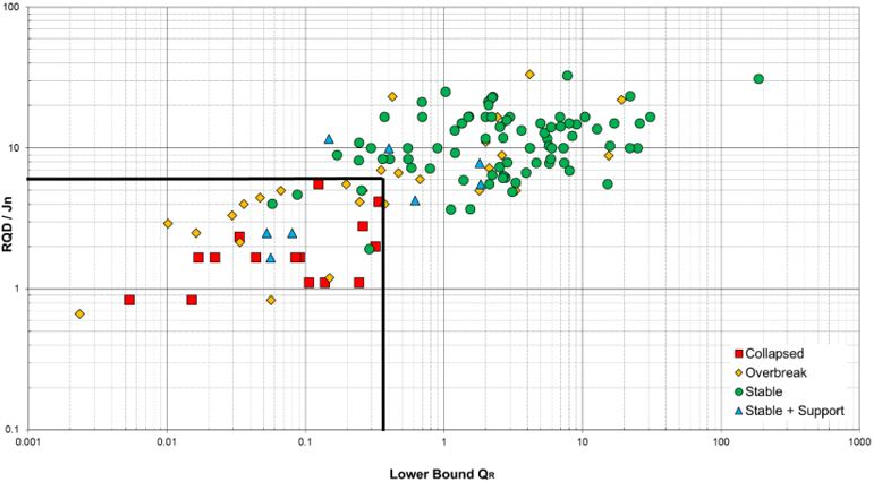
Previous studies indicates that most of the collapsed raises were associated with very blocky ground conditions, with RQD/Jn < 6 (Penney et al., 2018; Peck et al., 2011) and certainly < 2 (Peck et al., 2011; Peck and Lee, 2007).
In general, to ensure raisebore stability, it is crucial to measure RQD accurately and assess Jn correctly (Peck, 2000; Peck et al., 2011; Peck and Lee, 2007; Penney et al., 2018; Walls et al., 2019). The lower-bound QR plot with the RQD/Jn is considered the most significant plot among other parameters (Peck et al., 2011).
Case studies of lower bound Qr with RQD/Jn (Penney et al., 2018):
Jr/Ja - Shear Resistance Parameter
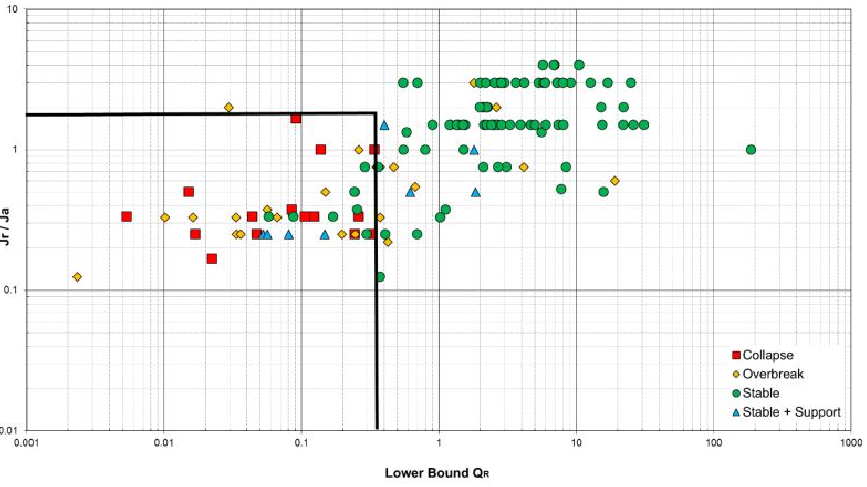
A low Jr/Ja ratio suggests poor frictional resistance, resulting in instability due to block wedge failure (Penney et al., 2018). Previous research indicates that most collapsed shafts have Jr/Ja values below 2. It is estimated that 30% of stable cases have a Jr/Ja ratio less than 2. Previous study also indicates that most of the collapsed rises have Jr/Ja values of 0.4, however the performance of the two raises with the lowest Jr/Ja values were stable and overbreak (Peck et al., 2011). According to the empirical database, the raise performance is less sensitive to the shear resistance factor Jr/Ja, compared to RQD/Jn factor (Lyle et al., 2017; Peck et al., 2011; Penney et al., 2018). The parameter of shear resistance should be used in conjunction with the blockiness evaluation to highlight areas of concern, rather than in isolation to establish possible stability difficulties (Penney et al., 2018).
Case studies of lower bound Qr with Jr/Ja (Penney et al., 2018):
Active Stress (Jw/SRF)
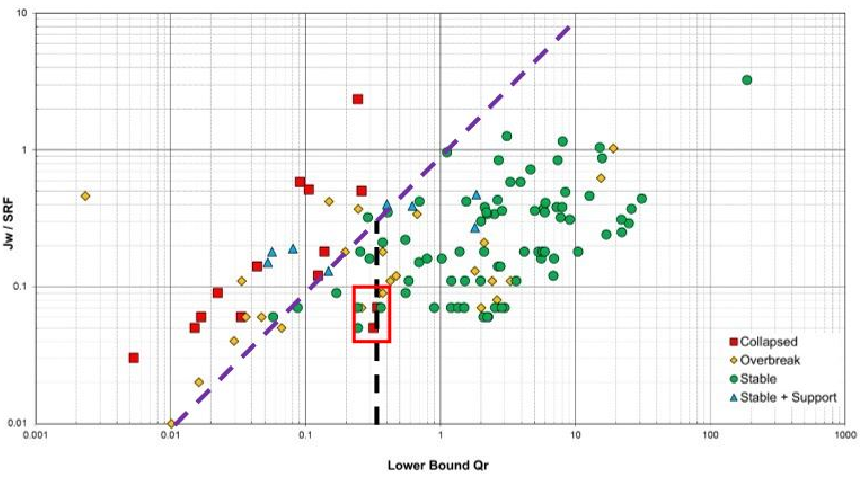
The most recent empirical database from 2018 indicates that there is no meaningful separation between the collapsed and stable raises based on the active stress component and the lower-bound Qr (Penney et al., 2018). low Jw/SRF are not associated with any increase of failure, and this parameter is not regarded as a reliable predictor of raisebore stability (Peck et al., 2011; Penney et al., 2018). This implies that the SRF values do not have an undue influence on the lower-bound Qr values, and large SRF values do not always indicate raise collapse.
However, if the empirical chart is observed in more detail, there seems to be a soft boundary between collapsed-overbreak shaft with the stable shaft along the inferred line in the figure below for both databases. The line indicates where the value of the active Jw/SRF equals to the Qr value. This indicates that if the active stress components outvalues the Qr, there is an increase probability of shaft failure. On the other hand, if the active stress parameter value falls higher than the inferred line, it does not automatically forecast collapse, as this part of area contains 2 stable cases (7%) along with 12 collapsed, 9 overbreak and 4 stable-with support cases. At the same time, there are two collapsed cases where the Qr value is higher than the Jw/SRF value, which is located near the lower-bound limit value Qr at 0.35.
Thus, it should be considered that the parameter Jw/SRF also can be used in conjunction with other parameters to predict the stability of the raisebore shaft, contradicting previous study results that disregard the active stress parameter as any useful predictor of raisebore stability (Lyle et al., 2017; Peck et al., 2011; Penney et al., 2018). However, at the same time, it should be noted that the reference is only as good as the data available and used in outlining the trends.
Case studies of lower bound Qr with Jw/SRF (Modified from (Penney et al., 2018)):
References
Drieka, E. 2023. Raisebore Stability Assessment in Carrapateena Mine and the Development of a Raisebore Stability App in the Mxrap. University of Exeter.
Lyle, R.R., Hudyma, M., Potvin, Y., 2017. Considerations for large-diameter raiseboring. Presented at the UMT 2017: First International Conference on Underground Mining Technology, 2017 11-13 October, Sudbury, Australian Centre for Geomechanics. https://doi.org/10.36487/ACG_rep/1710_47_Lyle
McCracken, A., Stacey, T.R., 1989. Geotechnical Risk Assessment of Large-diameter Raise-bored Shafts. Inst. Miner. Min. 309–316.
Peck, W., 2000. Determining the stress reduction factor in highly stressed jointed rock. Aust Geomech 35, 57–60.
Peck, W.A., Coombes, B., Lee, M.F., 2011. Fine-tuning raise bore stability assessments and risk. 11th AusIMM Undergr. Oper. Conf. 2011 Proc. 215–225.
Peck, W.A., Lee, M.F., 2007. Application Of The Q-System To Australian Underground Metal Mines; Proceedings Of The International Workshop On Rock Mass Classification In Underground Mining.
Penney, A., Stephenson, R., Pascoe, M., 2018. Raise bore stability and risk assessment empirical database update.
Walls, E.J., Joughin, W.C., Paetzold, H.-D., 2019. Geotechnical data analysis to select a feasible method for development of a long axis, large diameter vertical ventilation shaft. J. South. Afr. Inst. Min. Metall. 119. https://doi.org/10.17159/2411-9717/17/390/2019